Strain Gauge Instrumentation for Structural Laboratory Testing
Strain gauge instrumentation plays a critical role in modern structural engineering laboratories, enabling precise measurement of deformation, stress distribution, and structural response under various loading conditions. In experimental structural mechanics, accurate strain measurement is essential for validating design assumptions, calibrating numerical models, and understanding the real behavior of structural elements such as beams, slabs, columns, joints, and full-scale frames. At our laboratory, we specialize in advanced strain gauge instrumentation systems designed specifically for structural test setups. These systems are carefully developed to ensure high accuracy, reliability, and repeatability in demanding experimental environments.
What is Strain Gauge Instrumentation?
Strain gauge instrumentation refers to the complete system used to measure strain in structural elements. This includes strain gauges, wiring systems, signal conditioning units, data acquisition systems, and software for monitoring and analysis. A strain gauge is a sensitive sensor that measures the amount of deformation (strain) experienced by a material when subjected to external forces. When bonded to a structural surface, the strain gauge deforms along with the material, causing a change in electrical resistance. This change is then converted into measurable data using instrumentation systems. Importance of Strain Measurement in Structural Testing. Accurate strain measurement is fundamental to understanding structural performance. In laboratory environments, strain gauge instrumentation provides critical data that cannot be obtained through visual observation alone.
Importance of Strain Measurement in Structural Testing
Accurate strain measurement is fundamental to understanding structural performance. In laboratory environments, strain gauge instrumentation provides critical data that cannot be obtained through visual observation alone. Key benefits include:
- Validation of structural design models
- Monitoring stress distribution in critical regions
- Assessment of material behavior under loading
- Evaluation of cracking and damage progression
- Calibration of finite element models (e.g., ANSYS, ETABS)
- Verification of design codes and assumptions (e.g., AS 3600)
Without reliable strain measurement, it is impossible to fully understand the internal response of structural systems.
Applications in Structural Laboratory Test Setups
- Strain gauge instrumentation in structural laboratory testing plays a vital role in modern structural laboratory test setups, enabling engineers to accurately measure strain, stress distribution, and deformation under controlled loading conditions. In advanced structural testing laboratories, high-precision strain measurement systems are essential for analysing the real behaviour of structural elements such as beams, slabs, columns, and connections.
- One of the most important applications of strain gauge instrumentation in structural laboratory testing is in reinforced concrete experiments. Strain gauges are installed on concrete surfaces and embedded reinforcement to monitor strain development throughout the loading process. These measurements are critical for understanding crack initiation, crack propagation, and stress redistribution in structural elements, ensuring compliance with standards such as AS 3600. In structural laboratory test setups, this data is widely used to validate analytical models and improve design accuracy.
- In steel structural testing, strain gauge instrumentation is used to measure stress concentration and strain distribution in critical components such as welded joints, bolted connections, and beam sections. These strain measurement systems are particularly important in cyclic and seismic testing, where accurate data is required to evaluate ductility, stiffness degradation, and failure mechanisms. The use of structural testing instrumentation ensures reliable and repeatable results in demanding laboratory environments.
- Another key application is in composite and FRP structural systems. Strain gauges are applied to both the base material and strengthening layers to analyse bond behaviour and load transfer mechanisms. In experimental structural testing, this allows engineers to assess the effectiveness of strengthening techniques used in retrofitting and rehabilitation projects. Accurate strain data helps improve the performance of advanced materials such as fibre-reinforced polymers and geopolymer composites.
- Strain gauge instrumentation is also widely used in large-scale structural laboratory test setups, including full-scale frame testing, impact testing, and displacement-controlled loading experiments. In these complex systems, strain gauges are integrated with data acquisition systems (DAQ), load cells, and LVDTs to provide synchronized and high-resolution data. This integration is essential for capturing the relationship between load, displacement, and strain in real time, making strain measurement systems a core component of structural lab instrumentation.
- In addition, strain gauge instrumentation in structural laboratory testing plays a crucial role in validating numerical simulations developed using engineering software such as ANSYS, ETABS, and SAP2000. By comparing experimental data with analytical results, engineers can refine models and improve the accuracy of structural predictions. This is particularly important in research involving innovative materials and complex structural behaviour.
- Furthermore, strain gauges are essential for identifying failure mechanisms and damage progression in structural elements. By installing gauges in critical regions, engineers can detect yielding, cracking, and ultimate failure with high precision. This information is fundamental for improving safety, durability, and performance in modern structural design.
- Overall, strain gauge instrumentation in structural laboratory testing provides high-accuracy data, reliable performance, and detailed insight into structural behaviour. Its application in structural laboratory test setups is essential for advancing engineering research, optimising design methods, and delivering safe and efficient structural solutions.
Components of a Strain Gauge Instrumentation System
A reliable and high-performance strain gauge instrumentation system is essential for accurate data collection in structural laboratory testing. In modern structural laboratory test setups, each component of the instrumentation system must work together seamlessly to ensure precise strain measurement, stable signal transmission, and high-quality data acquisition. Understanding the key components of a strain measurement system is critical for achieving consistent and repeatable results in experimental structural testing.
The most important component is the strain gauge sensor itself. Strain gauges are typically foil-type electrical resistance sensors that are bonded directly to the surface of structural elements such as concrete, steel, or composite materials. When the structure is subjected to loading, the strain gauge deforms along with the material, causing a change in electrical resistance. This change is the basis of all strain gauge instrumentation in structural testing, making sensor selection a crucial step. Factors such as gauge length, resistance value (e.g., 120Ω or 350Ω), and temperature compensation must be carefully considered.
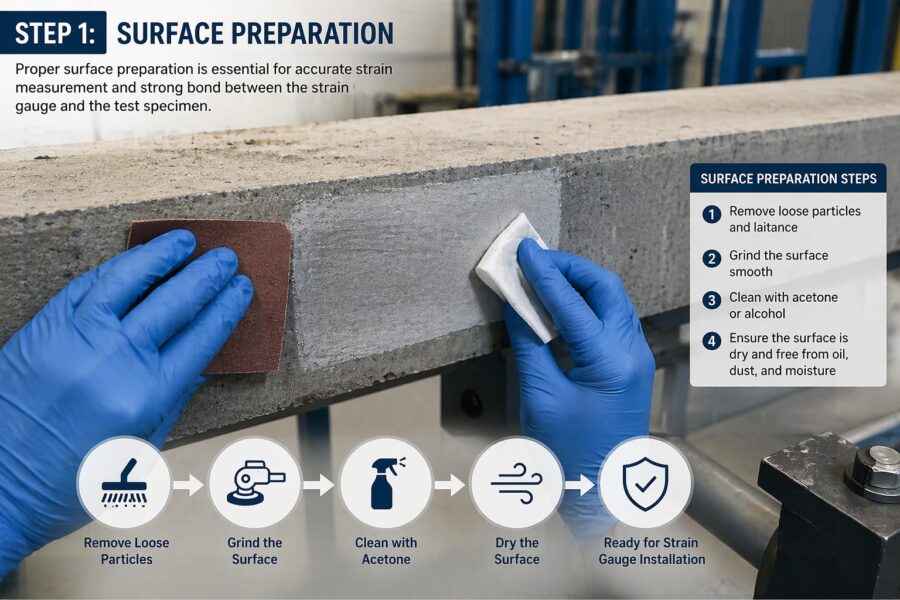
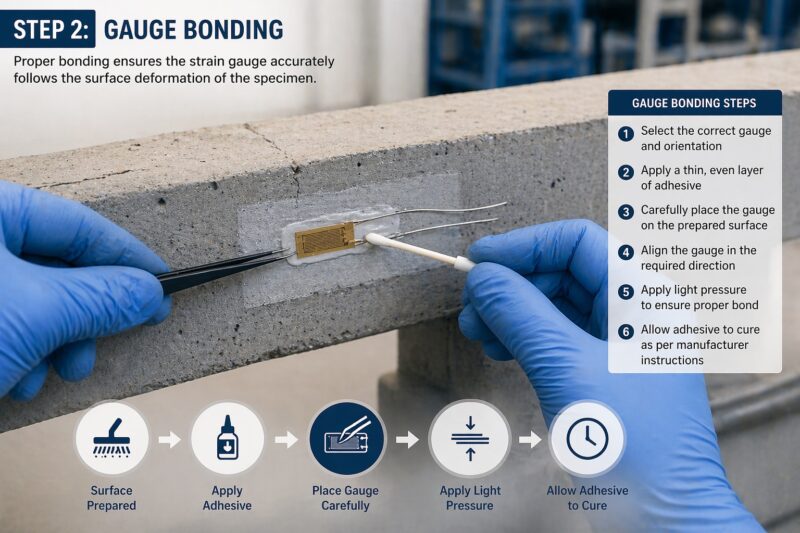
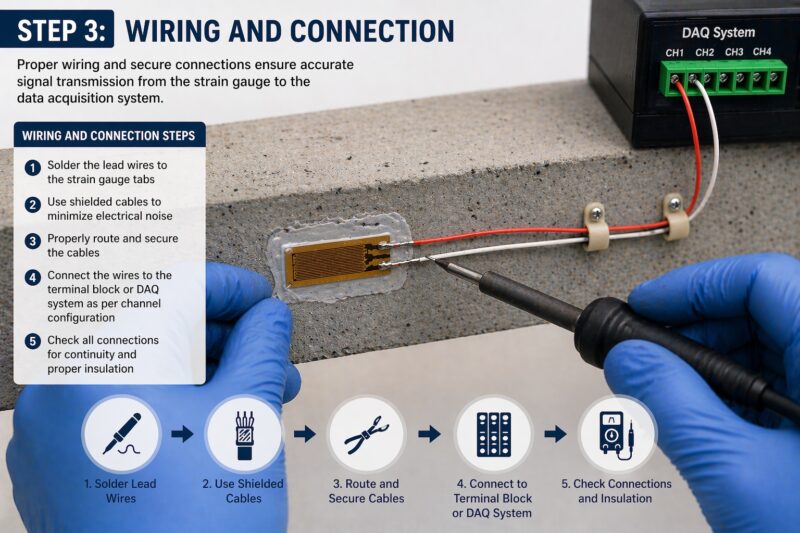
Another critical component is the surface preparation and bonding system. Proper surface preparation ensures that the strain gauge is securely attached and accurately reflects the deformation of the structural element. This process includes grinding, cleaning, and applying specialised adhesives. In structural laboratory applications, poor bonding can lead to inaccurate readings or complete sensor failure, making this stage extremely important. The wiring and connection system is also a key part of any strain measurement system. High-quality, shielded cables are used to transmit signals from the strain gauges to the data acquisition system. Proper soldering, insulation, and cable protection are essential to minimise electrical noise and signal interference, especially in complex structural laboratory test setups involving multiple sensors and channels.
To convert the small electrical signals from strain gauges into usable data, a signal conditioning unit is required. Signal conditioners amplify the signal, filter out noise, and stabilise the output for accurate measurement. In advanced strain gauge instrumentation systems, these units ensure a high signal-to-noise ratio and reliable performance even in demanding experimental conditions. The data acquisition system (DAQ) is the central component that collects, records, and processes all measurement data. In structural testing laboratories, DAQ systems are typically multi-channel, allowing simultaneous monitoring of strain gauges, load cells, and displacement sensors such as LVDTs. High sampling rates and synchronization capabilities are essential features of a professional structural testing instrumentation system. In addition, data monitoring and analysis software plays a vital role in interpreting the collected data. These platforms provide real-time visualisation of strain readings, enabling engineers to observe structural behaviour during testing. The software also allows for data storage, analysis, and export for further evaluation and reporting.
Finally, protective coatings and environmental protection systems are used to safeguard strain gauges during testing. In many experimental structural testing scenarios, sensors are exposed to dust, moisture, or mechanical damage. Protective layers ensure long-term stability and reliability of the instrumentation system. Overall, a complete strain gauge instrumentation system consists of carefully integrated components, including sensors, bonding materials, wiring, signal conditioning units, data acquisition systems, and analysis software. Together, these elements provide accurate, reliable, and high-resolution data, making them indispensable in modern structural laboratory test setups.
Installation Process in Structural Test Setups
The accuracy of strain gauge instrumentation depends heavily on proper installation. In structural laboratories, the installation process follows strict procedures:
Step 1: Surface Preparation
Step 2: Gauge Bonding
Step 3: Wiring and Connection
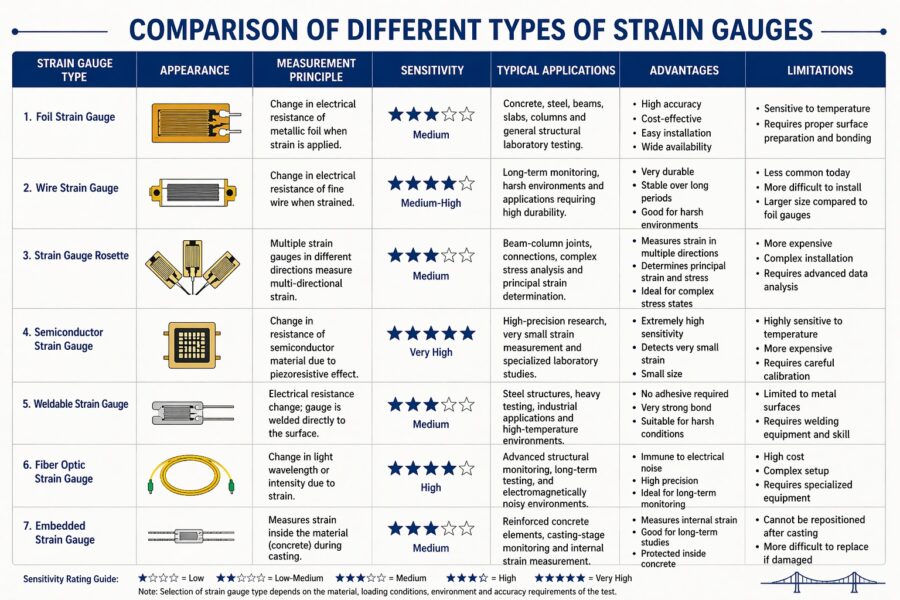
Various Types of Strain Gauges in Structural Laboratory Testing
In modern structural laboratory testing, selecting the appropriate type of strain gauge instrumentation is essential for achieving accurate and reliable strain measurement. Different types of strain gauges are designed to suit specific materials, loading conditions, and experimental requirements. Understanding these variations allows engineers to optimise strain measurement systems for both small-scale material tests and large-scale structural experiments.
The most commonly used type in structural laboratory test setups is the electrical resistance strain gauge, also known as a foil strain gauge. These gauges consist of a thin metallic foil pattern mounted on a backing material. When bonded to a structural surface, such as concrete or steel, the foil deforms with the material, causing a change in electrical resistance. This type of strain gauge instrumentation is widely used due to its high accuracy, affordability, and ease of installation in experimental structural testing.
Another important category is the wire strain gauge, which operates on a similar principle but uses fine wire instead of foil. Although less common in modern laboratories, wire strain gauges are still used in specific applications where higher durability or different sensitivity characteristics are required. In structural testing instrumentation, they are sometimes preferred for long-term monitoring or harsh environmental conditions.
For more complex stress analysis, strain gauge rosettes are used. These consist of multiple strain gauges arranged in specific orientations, typically at 0°, 45°, and 90°. Rosette strain gauges allow engineers to measure strain in multiple directions at a single point, making them highly valuable in structural laboratory test setups involving complex stress states, such as beam-column joints or connection zones. This type of strain measurement system is essential for determining principal stresses and understanding multidirectional behaviour.
In advanced research applications, semiconductor strain gauges are also used. These gauges offer significantly higher sensitivity compared to traditional foil gauges, making them suitable for detecting very small strains. However, they are more sensitive to temperature variations and require careful calibration. In experimental structural testing, semiconductor gauges are typically used in specialised research rather than routine laboratory experiments.
Another widely used category is the weldable strain gauge, particularly in steel structure testing. These gauges are designed to be directly welded onto steel surfaces, eliminating the need for adhesive bonding. This makes them highly suitable for structural testing instrumentation in environments where bonding may be difficult or unreliable. Weldable gauges are commonly used in heavy structural testing and industrial applications.
For non-contact measurement, optical strain gauges, such as fibre optic sensors, are increasingly used in advanced structural laboratory testing. These systems use light signals to measure strain and are highly resistant to electromagnetic interference. Although more expensive, they are ideal for long-term monitoring and high-precision applications.
Additionally, embedded strain gauges are used in concrete structures, where sensors are placed within the material during casting. These gauges are particularly useful in monitoring internal strain in reinforced concrete elements during experimental studies.
Overall, the selection of the appropriate type of strain gauge instrumentation in structural laboratory testing depends on the specific requirements of the experiment, including material type, loading conditions, and environmental factors. By choosing the right strain measurement system, engineers can ensure accurate data collection, reliable performance, and improved understanding of structural behaviour.