
Column Buckling Calculator
Calculate Euler critical buckling load, slenderness ratio, effective length, and factor of safety.
Input Data
Pcr = π²EI / (KL)²
Slenderness Ratio:
λ = KL / r
Radius of Gyration:
r = √(I / A)
Calculation Results
Column Buckling Calculator – Euler Critical Load and Slenderness Ratio
Our Column Buckling Calculator is a simple and practical online tool designed to help engineers, students, researchers, and construction professionals estimate the critical buckling load of a column using Euler buckling theory. Column buckling is one of the most important concepts in structural engineering because a compression member can fail suddenly by sideways instability, even before the material reaches its full compressive strength. When a column is subjected to an axial compression load, it may fail by crushing or by buckling. Short and stocky columns usually fail by material crushing, while long and slender columns are more likely to fail by buckling. This calculator focuses on the Euler critical buckling load, which is commonly used for slender columns under ideal compression conditions. The calculator uses the standard Euler buckling equation:
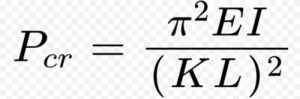
where Pcr is the critical buckling load, E is the Young’s modulus, I is the moment of inertia, L is the actual column length, and K is the effective length factor. The effective length factor depends on the column end support conditions, such as pinned-pinned, fixed-fixed, fixed-pinned, or fixed-free. These support conditions have a major effect on the buckling resistance of the column. This online Euler buckling calculator allows users to input the column length, Young’s modulus, moment of inertia, cross-sectional area, applied axial load, and support condition. Based on these values, the calculator provides the effective length, radius of gyration, slenderness ratio, Euler critical load, load ratio, and factor of safety. These results help users quickly understand whether the applied axial load is below or above the estimated critical buckling capacity.
The slenderness ratio is another important result provided by this calculator. It is calculated using the effective length and radius of gyration. A higher slenderness ratio means the column is more vulnerable to buckling, while a lower slenderness ratio usually indicates a more compact compression member. For this reason, checking the slenderness ratio is an essential part of preliminary column design and structural stability assessment. This column stability calculator is useful for preliminary design checks, educational purposes, engineering studies, and quick comparison of different column sizes and support conditions. For example, users can compare how increasing the moment of inertia or reducing the effective length can significantly increase the buckling capacity of a column. This makes the calculator helpful for understanding the relationship between geometry, material stiffness, and structural performance. However, this tool is intended for educational and preliminary engineering calculations only. Real structural design must consider additional effects such as material yielding, initial imperfections, eccentric loading, residual stresses, connection stiffness, second-order effects, and relevant design standards. Final column design should always be checked by a qualified structural engineer according to the applicable code, such as Australian Standards, Eurocode, AISC, or other relevant structural design codes. Use this free Column Buckling Calculator to estimate Euler critical load, check column slenderness, and improve your understanding of compression member stability in structural engineering.