
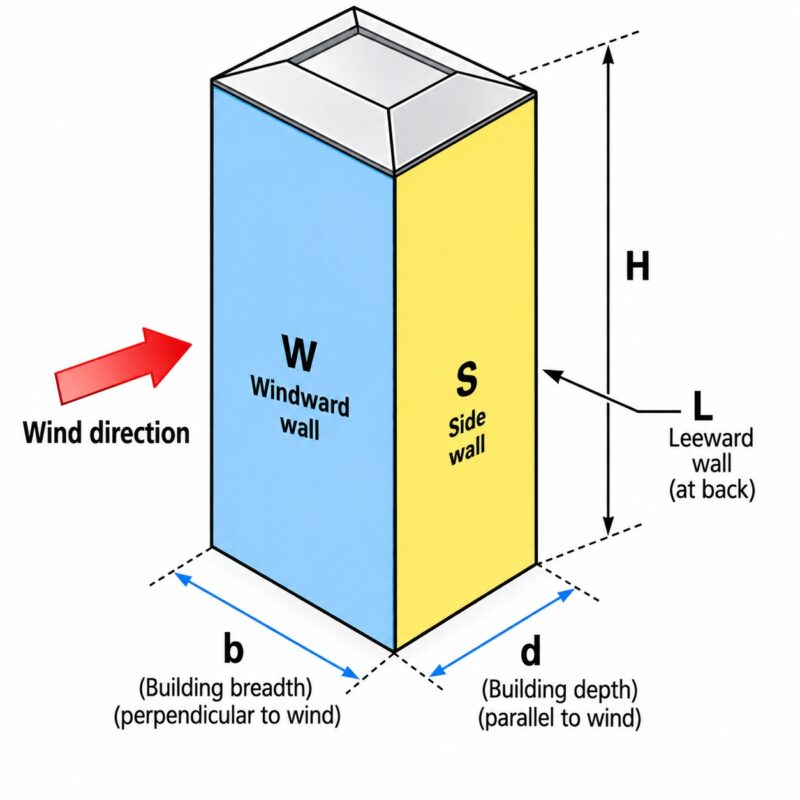
This calculator is designed to determine the external wind pressure coefficient (Cp,e) for rectangular buildings in accordance with AS/NZS 1170.2:2011. It considers three main building surfaces: the windward wall (W), side walls (S), and leeward wall (L).

Users enter the building height (h), breadth (b), depth (d), and roof pitch angle (α). Based on these parameters, the calculator determines the applicable external pressure coefficients using Tables 5.2(A), 5.2(B), and 5.2(C) of the Australian Standard.

For buildings exceeding 25 m in height, the windward wall coefficient is automatically taken as +0.8, and wind speed must be considered as varying with height.

The calculator provides a simplified, interactive method for identifying wind pressure coefficients and understanding their relationship with building geometry and wind direction.

Important: This tool calculates external pressure coefficients only. Final design wind pressures require additional factors, wind speed calculations, and applicable structural design checks.

External Pressure Coefficient Cp,e
AS/NZS 1170.2:2011 • Rectangular enclosed building • Gable roof • W, S and L
1. Building geometry
Entered once and reused.
This simplified calculator determines Cp,e only. It does not calculate Ka, Kc,e, K, Kp, Cfig,e or wind pressure.
2. Select surface
WWindward wall
SSide wall
LLeeward wall
W — Windward wall • Table 5.2(A)
Cp,e = —
IMPORTANT — TALL BUILDINGS (h > 25 m): For the windward wall, AS/NZS 1170.2:2011 Table 5.2(A) requires Cp,e = +0.8 and wind speed varying with height. Calculate the design wind speed and corresponding windward pressure at appropriate elevations; do not apply one uniform reference-height wind pressure over the full windward wall. This tool calculates Cp,e only, not wind speed, wind pressure or complete tall-building wind actions. Consider dynamic response requirements under Section 6 where applicable.
Table 5.2(A): h is read automatically from Part 1. For h > 25 m, Cp,e = +0.8 and wind speed varies with height. For a building on ground with h ≤ 25 m, the table permits +0.8 with wind speed varying with height, or +0.7 when wind speed is taken at z = h.
S — Side wall • Table 5.2(C)
Cp,e = —
Horizontal distance from windward edgeCp,e
0 to 1h−0.65
1h to 2h−0.50
2h to 3h−0.30
> 3h−0.20
Table 5.2(C): Cp,e changes with horizontal distance from the windward edge. The coloured strip shows every Table 5.2(C) zone that occurs within the entered building depth d.
L — Leeward wall • Table 5.2(B)
Cp,e = —
Table 5.2(B), gable roof, θ = 0°: for α < 10°, Cp,e depends on d/b. At α = 10°, 15° and 20°, the listed values are −0.3, −0.3 and −0.4 respectively. For α ≥ 25°, Cp,e varies from −0.75 at d/b ≤ 0.1 to −0.5 at d/b ≥ 0.3. Intermediate d/b and α values are linearly interpolated.
JS